Class 12: Technology and Cost
Textbook reading: Kreps, Chapter 11, sections 11.1 and 11.2 through “Returns to Scale and Total Cost” (pages 247 to 258), plus the two subsections at the end, “Solving the Cost-Minimization Problem Graphically” and “Inputs without Clearly Defined Prices.” Skip everything with a partial derivative in it, and skip “Rising Marginal Cost and Technology.” Chapter 12 is not assigned; the cost vocabulary it formalizes (fixed, variable, average, marginal, sunk) is in Class 6 and on this page.
Key Ideas
Where a cost curve comes from
- Total cost function: the cheapest way to make each quantity at today’s input prices
- Flexible technologies have many recipes, rigid ones have one. When an input gets dear, a flexible firm leans on the other; a rigid firm pays the full increase (fast food added kiosks as wages rose; a tasting-menu kitchen cannot)
Average and marginal cost
- Average total cost (ATC): the all-in cost of a typical unit. High at small output because the fixed cost is spread thin (a food truck’s permit costs the same at 40 lunches or 400); rising at large output because each extra unit costs more than the last
- Marginal cost (MC) crosses ATC at its minimum. Pure arithmetic: a new hire paid below the team’s average pulls the average down, one paid above pulls it up
- Efficient scale: the output where ATC is lowest
Price against minimum ATC
- Profit per unit is p − ATC, so at p = minimum ATC the firm just breaks even, at the efficient scale. Below that price no output is profitable
- Whether a loss means closing depends on which costs closing would save
Sunk versus avoidable
- Sunk: already paid, unrecoverable. Avoidable: paid only if the firm operates. Only avoidable costs enter a decision
- The same bill changes bins: a lease is avoidable before you sign and sunk after
- Unpriced inputs count at opportunity cost: an owner’s hours are worth what they would earn elsewhere
Problems of the Day
Q34: From a Production Table to a Cost Curve
A bread kiosk pays $200 a day for its stall and oven whether or not it opens, $120 a day for each worker, and $1 of ingredients per loaf. It can sell as many loaves as it likes at $4 each. Most of its cost table is filled in below.
| Workers | 0 | 1 | 2 | 3 | 4 | 5 | 6 | 7 | 8 |
|---|---|---|---|---|---|---|---|---|---|
| Loaves per day (Q) | 0 | 60 | 140 | 210 | 260 | 300 | 330 | 350 | 360 |
| Total cost (TC) | 200 | 380 | 580 | ___ | 940 | 1,100 | ___ | 1,390 | 1,520 |
| Average total cost (ATC) | n/a | 6.33 | 4.14 | 3.67 | ___ | 3.67 | 3.79 | ___ | 4.22 |
| Marginal cost (MC) | n/a | 3.00 | ___ | 2.71 | 3.40 | ___ | 5.00 | 7.00 | 13.00 |
| Marginal revenue (MR) | 4 | 4 | 4 | 4 | 4 | 4 | 4 | 4 | 4 |
| Total revenue (TR) | 0 | 240 | ___ | 840 | 1,040 | 1,200 | 1,320 | ___ | 1,440 |
| Profit | −200 | −140 | −20 | 70 | ___ | ___ | 70 | 10 | −80 |
Fill in the ten blanks. Marginal cost is the change in total cost divided by the change in loaves, so it is a cost per loaf, not per worker.
The graph below plots ATC, MC, and the horizontal line MR = $4 against loaves. Marginal cost is drawn at the middle of each worker’s range of loaves; the last point, $13, is off the chart. Where does MC cross ATC? Why must it cross there, and not somewhere else?
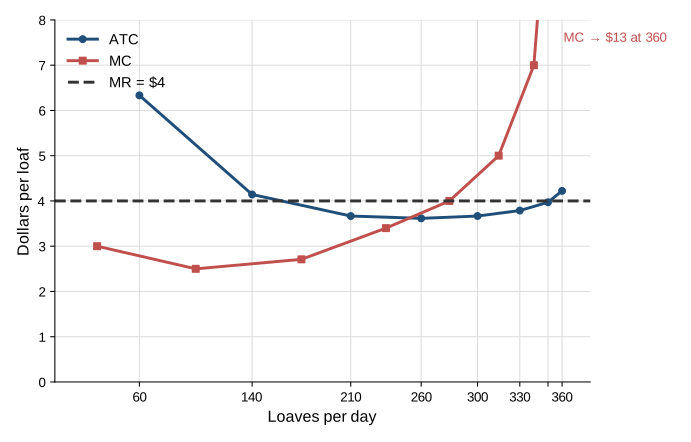
How many workers should the kiosk hire? Find the answer twice: from the profit row, and from where MC meets MR on the graph. Then draw the profit at that output as a rectangle on the graph: height, width, and area.
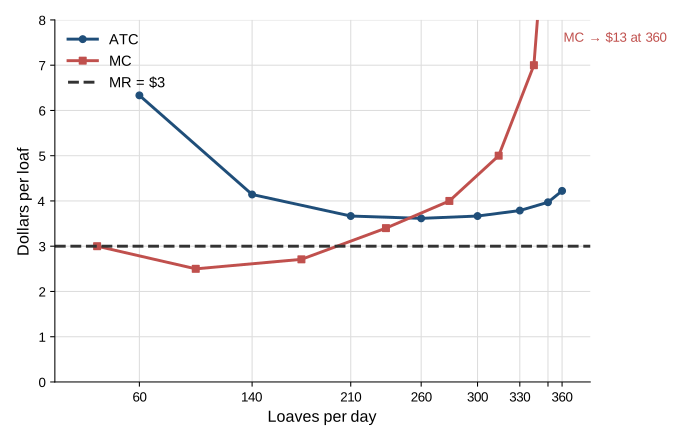
The price falls to $3. Is there any output at which the kiosk makes a profit? How can you tell from the picture alone? Find the best number of workers anyway, and the profit there. Should the kiosk open, given that the $200 is paid either way? Would your answer change if the $200 could be saved by staying closed? Name the cost per loaf that the price must cover in each case.
Q35: The Cheapest Way to Make a Hundred
Two workshops each make 100 units a week. Flexi can use any of these combinations of labor hours and machine hours:
| Labor hours | 50 | 40 | 32 | 26 | 22 | 20 |
|---|---|---|---|---|---|---|
| Machine hours | 10 | 13 | 17 | 22 | 28 | 35 |
Rigid’s equipment works only one way: 32 labor hours and 17 machine hours, no more and no less. Labor costs $20 an hour and machine time $30 an hour.
Price out each of Flexi’s combinations. Which is cheapest? What does each workshop pay to make 100 units?
Machine time doubles to $60 an hour. What does each workshop pay now? Whose cost rose more, and by how much?
Q36: Sunk, Fixed, and Avoidable
Riverside Creamery is an ice cream shop. Last year its owner paid $60,000 for a custom batch freezer that no one else wants. The shop is on a 12-month lease at $2,000 a month with 8 months left, and the landlord will not allow subletting. At current volume, labor and ingredients cost $6,000 a month and revenue is $7,500 a month. The owner says: “We lose money every month once you count the lease and the freezer. We should close.”
Sort every cost mentioned into bins: sunk (unrecoverable) versus avoidable (paid only if the shop operates).
Over the next 8 months, how much does the shop lose if it stays open? If it closes today? Is the owner right?
When the 8 months are up, the landlord offers to renew at the same $2,000 a month. Should the owner sign?
Q34. (a) TC: 770 at three workers, 1,250 at six. ATC: 940 / 260 = 3.62 at four, 1,390 / 350 = 3.97 at seven. MC: 200 / 80 = 2.50 at two, 160 / 40 = 4.00 at five. TR: 560 at two, 1,400 at seven. Profit: 100 at four and 100 at five. (b) MC crosses ATC at its minimum, four workers and 260 loaves, where ATC is $3.62. It has to: while the next loaf costs less than the average, adding it pulls the average down; once it costs more, adding it pulls the average up. The average can only stop falling at the point where the marginal loaf costs exactly the average. (c) The profit row peaks at $100 for four or five workers. On the graph, MC rises through MR = 4 at the fifth worker, whose loaves cost exactly $4 each, so the firm is indifferent between four and five. The profit rectangle at 300 loaves has height P − ATC = 4 − 3.67 = $0.33 and width 300, area $100 (at 260 loaves, 0.38 × 260 = $100 too, up to rounding). The kiosk stops hiring when the next worker’s loaves cost more to make than they sell for; ATC tells you how much profit that earns, but MC tells you where to stop. (d) The MR = 3 line lies below ATC at every output, so no rectangle has positive area and no number of workers makes a profit. MC crosses $3 between three workers (MC 2.71) and four (MC 3.40), so hire three: TR 630, TC 770, profit −$140. Open: closed, the kiosk loses the full $200. Open with three workers it loses $140, because revenue covers all $570 of avoidable cost and $60 of the stall. The relevant cost per loaf is average variable cost, 570 / 210 = $2.71, and the price of $3 is above it. If the $200 could be saved by closing, the stall becomes avoidable, every cost is in play, and the price must cover ATC; its lowest value is $3.62, which $3 does not reach, so close. Same table, same price, different answer, because the question is never whether the firm makes a profit but whether operating beats the alternative.
Q35. (a) Flexi’s combinations cost 1,000 + 300 = 1,300; 800 + 390 = 1,190; 640 + 510 = 1,150; 520 + 660 = 1,180; 440 + 840 = 1,280; 400 + 1,050 = 1,450. Cheapest: 32 labor hours and 17 machine hours, $1,150. Rigid uses the same combination, so both pay $1,150; at these prices the inflexibility costs nothing. (b) At $60 Flexi’s combinations cost 1,600; 1,580; 1,660; 1,840; 2,120; 2,500, so Flexi moves to 40 labor hours and 13 machine hours and pays $1,580, just under the 50-and-10 combination at $1,600. Rigid is stuck at 32 and 17 and pays $1,660. Flexi’s cost rose $430, Rigid’s $510; the $80 difference is what the ability to substitute is worth. Both firms are hurt by the dearer input, but Flexi softens the blow by leaning on labor, and Rigid has nothing to lean on.
Q36. (a) Sunk: the $60,000 freezer; the money is gone and the machine cannot be sold. Fixed but unavoidable: the lease, 8 × 2,000 = $16,000, payable open or closed. Avoidable: labor and ingredients, $6,000 a month. (b) Open: 8 × (7,500 − 6,000) − 16,000 = −$4,000. Closed: −$16,000. The owner is right that the shop loses money and wrong that closing helps: staying open is better by 8 × 1,500 = $12,000, because each month’s revenue covers all the avoidable cost with $1,500 to spare, and the lease and the freezer are paid either way. (c) No. At renewal the rent is a cost she can still avoid, so it moves bins: 7,500 − 6,000 − 2,000 = −$500 a month. The same $2,000 was irrelevant in (b) and decisive in (c); what changed is not the cost but whether the decision can still touch it.